
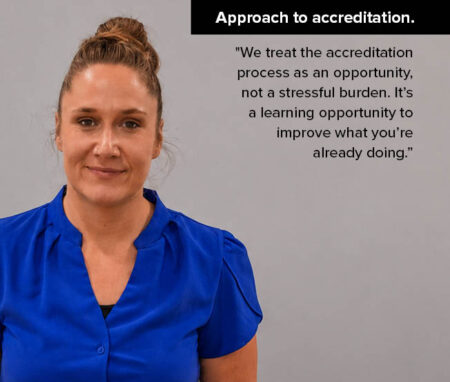
“The whole accreditation journey probably improved team cohesion. We just came together and got through it instead of just one person trying to do it all.” For Shae Goldspink, quality in general practice starts with relationships. “Tumba’s a small close-knit regional area,” she says. “We’ve got a really strong sense of connection and resilience.” That same sense of connection shapes the practice’s approach to patient care. “We’re relationship driven and let the patients lead the care. We don’t just treat the medical condition, but the person as a whole.”
Shae says quality and safety are reflected in the everyday systems and habits running behind the scenes:
-
accurate records
-
risk management
-
staff training
-
evidence-based care
-
strong clinical governance
“It’s about having those high standards of clinical and administrative practice.” Having stepped into the Practice Manager role shortly before her first accreditation experience, Shae admits she initially felt nervous. What stood out about working with QPA? “The self-assessment was really easy to understand and set out well. The support was there, and everything was broken down into achievable steps.” This is what QPA’s whole-of-cycle approach is designed to achieve: less uncertainty, more support and a clearer pathway through accreditation. Her advice for other practices preparing for accreditation? “Start early, keep your documentation organised and involve the whole team and treat the accreditation process as an opportunity, not a stressful burden. It’s really just a learning opportunity to improve what you’re already doing.”
What accreditation helped achieve:
-
Clearer team cohesion
-
Greater confidence around systems and processes
-
Clear documentation
-
Shared responsibility across the practice
-
Reduced uncertainty around accreditation
Read more about how other practice’s are delivering excellence in quality patient care