
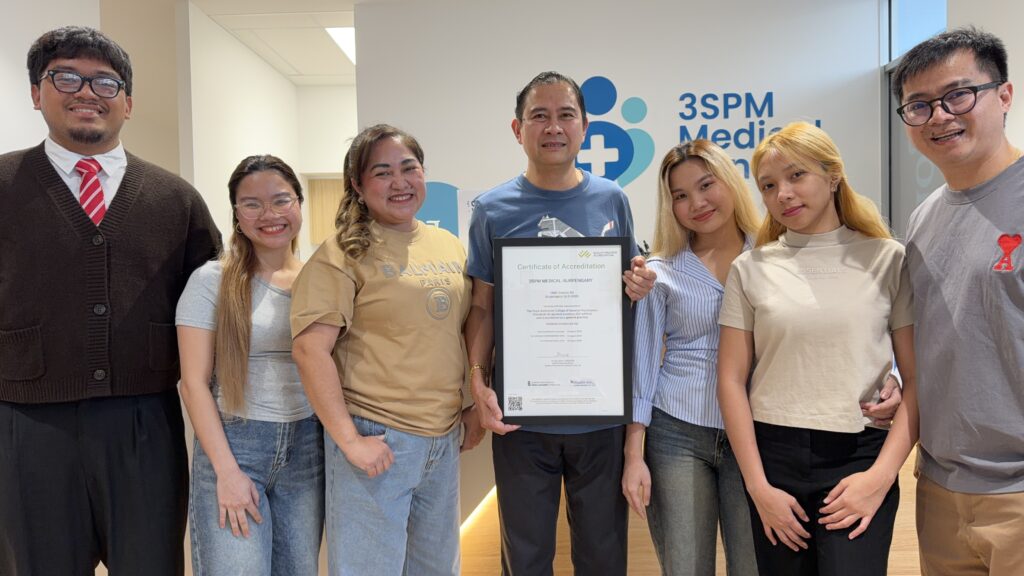
When Dr Esteban Mondia set out to establish his own general practice, he knew exactly what we wanted – to serve a community where access to affordable primary healthcare was needed, and to create a practice where relationships and quality care came before patient volume.
Following years practicing in other clinics across rural and regional Queensland, Dr Mondia, opened the doors to 3SPM Medical Centre in Burpengary in December 2025. From the outset he was committed to resisting what he calls “six-minute medicine”.
“When we were practising in the rural area, we always focused on patient care and relationships, and that’s what we want to create here as well,” he says. “If patients need time, at least we can give them time.”
It also means building quality into the practice from day one.
Building a practice from scratch
3SPM is very much a family practice – in more ways than one.
The name itself brings together the names of Dr Mondia’s three children, the Pilapil family name and Mondia. Practice Manager and Registered Nurse Rishell Pilapil is Dr Mondia’s sister-in-law, while several other family members work at the front desk.
The team brings together different skills, including nursing, accounting and IT, but shares a common focus on creating a welcoming practice where patients feel known and respected.
For Dr Mondia, establishing relationships and trust with patients has been one of the practice’s greatest achievements.
“When you know them and they know that you have an open practice which is non-judgmental and they open up, then it’s very satisfying that they trust you and that you are able to work with them and make a difference.”
That approach appears to be resonating. The practice has grown largely through word of mouth and, within months of opening, has gone from seeing one or two patients a day to being fully booked.
Quality from day one
For Rishell, achieving accreditation has been one of the proudest moments in the practice’s short history.
“The accreditation – doing everything from scratch – I think that’s the one I’m proud of,” she says.
Dr Mondia had already experienced multiple accreditation processes across general practice and hospital settings. Before opening 3SPM, he spent several years reviewing standards and guidelines so systems could be designed correctly from the beginning.
“We try to make sure that everything that will be put in place from scratch will really be to the standards. And not start any bad habits at all,” he says.
“The guidelines are there to keep us safe. And if we have the opportunity to follow them and implement them, we should.”
For Rishell, quality is also about making those systems part of everyday behaviour – from checking that reception staff use three patient identifiers to ensuring protocols are consistently followed.
Accreditation as education
Despite Dr Mondia’s previous accreditation experience, working with QPA brought fresh insights.
“I thought that I had done and learned already, because I’ve been doing maybe five or six accreditations, including hospitals,” he says. “But the advice that they shared with me really made me better and made everything better here as well.”
What particularly stood out was the collegiate approach of the QPA survey team.
“When they give you feedback, it’s just like an educator giving you advice to make it better,” Dr Mondia says.
“There’s no judgement,” Rishell adds.
“Yes, it’s more collegiate,” says Dr Mondia.
The clarity of the process also made it easier for a relatively new team to turn advice into action.
“The directions are clear. What needs to be done is very clear, so we are able to implement it very easily because of this clarity – even our team members new to general practice.” Dr Mondia says.
What changed?
Accreditation helped 3SPM strengthen systems across the practice, from recalls and closing the gap for patients to medication processes and emergency preparedness.
For Dr Mondia, the latter provided an important reminder. His rural GP experience had taught him to prepare for serious emergencies, but working in a metropolitan setting had made some events seem less likely.
The accreditation process challenged that assumption and prompted the team to review its emergency medication and equipment.
“If you’re not preparing for those things to occur, then it’s going to predispose you to a risk,” he says.
Accreditation has also helped create more consistent workflows. Processes that had previously relied on individuals are becoming more systematic, forms have been updated, digital systems improved and the practice’s young team is being coached to understand not just what needs to happen, but why.
A culture built on respect
For Dr Mondia and Rishell, continuous improvement depends as much on culture as it does on systems.
Dr Mondia’s advice is to remain open-minded, accept mistakes and avoid knee-jerk changes. Instead, improvements should be discussed with the team and implemented in a way everyone understands and supports.
Rishell adds another essential ingredient: respect.
“When we sit down in a meeting, everybody can talk about anything, as long as there’s respect,” Dr Mondia says. “There’s no boss, no senior staff, no junior staff, and everybody has to speak. There’s equality when we are at the meeting table.”
It is a philosophy that fits neatly with the practice they set out to create – personal, inclusive and focused on doing things well from the beginning.
For practices embarking on accreditation themselves, Rishell’s advice is equally straightforward.
“Ask anything and everything, because they will help you. Don’t be afraid to ask anything,” she says. “And engage with the self-assessment because that helped me with all the paperwork and implementing as well.”
Dr Mondia agrees.
“Before you set things up, look at the standards first. And don’t be ashamed to ask questions if you don’t understand, so that you can implement it way beforehand. You start with the right footing.”
For a practice that has grown from one or two patients a day to a full appointment book in less than a year, that right footing is already proving valuable.
Interested in how QPA’s whole-of-cycle approach can help your practice build quality into everyday care?
Get in touch with our team to learn more.