
In a rural township of around 1,700 people, relationships matter.
At Tallangatta Medical Centre in north-east Victoria, patients are often known not just by their medical history, but by their families, their stories and their long connection to the community.
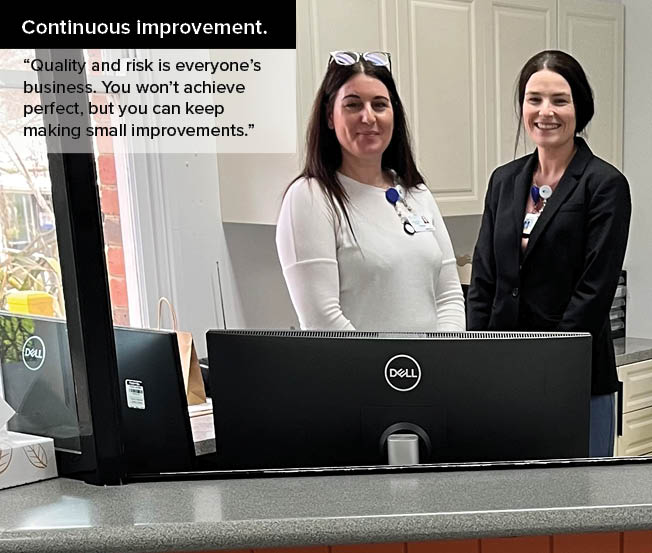
For Practice Manager Grace Bannerman and Quality and Risk Manager Evelyn Keogh, quality care is built on two things: strong relationships and strong systems.
Together, they underpin the practice’s commitment to delivering safe, consistent and person-centred care.
The challenge
Like many regional practices, Tallangatta Medical Centre operates in a complex environment.
As part of Tallangatta Health Service, its GPs work across the medical centre, hospital and residential aged care service, creating a highly integrated model of care. While that brings significant benefits for patients, it also requires strong governance, clear communication and consistent systems.
The team was also navigating organisational change when accreditation preparations began.
The Practice Manager at the time left unexpectedly, creating additional pressure during an already demanding period.
“It was stressful,” Evelyn says. “But every time we spoke with Brittany from QPA, we’d leave feeling calmer and clearer about what we needed to focus on.”
For Grace, who stepped into the Practice Manager role just weeks before the survey visit, the support proved invaluable.
“The support was always there. We could email, call or organise a meeting whenever we needed guidance.”
A partnership approach
Tallangatta Medical Centre recently completed its second accreditation cycle with QPA.
For Evelyn, who has extensive experience across multiple healthcare accreditation programs, the difference in approach was immediately apparent.
“QPA partners with you,” she says. “It’s not a case of being told what you need to do and then someone coming in to catch you out.”
Rather than focusing solely on compliance, the accreditation process centred on identifying priorities, understanding gaps and building practical solutions.
Through QPA Connect, the team could clearly see where they were performing well and where further work was needed. Combined with ongoing support from the QPA team, it transformed what could have been an overwhelming process into a manageable one.
The experience reinforced an important lesson: accreditation works best when it is viewed as an ongoing process of improvement rather than a single event.
What changed?
The accreditation process highlighted opportunities to strengthen systems, improve documentation and create greater consistency across the practice.
Some improvements were highly visible: enhanced patient information resources, strengthened infection control measures, and a ‘quality board’ that shares feedback and improvement initiatives with patients.
Others happened behind the scenes.
Clinical recall processes were strengthened. Policies and procedures were reviewed and clarified. Governance systems were refined. Staff safety processes were enhanced.
Importantly, the work also helped reduce reliance on individual knowledge by documenting key processes more consistently.
“When people know each other well, especially in small communities, it’s easy to become relaxed about things,” Evelyn says. “Accreditation helps make sure the systems underpinning patient care are there when they’re needed.”
The team also introduced a GP buddy system to strengthen continuity of care and ensure seamless clinical coverage during periods of clinician absence.
Quality starts with listening
While systems are important, the Tallangatta Medical Centre team believes quality begins with understanding what matters most to patients.
The health service maintains strong community engagement through consumer advisory groups, feedback mechanisms and ongoing conversations with patients. Those insights directly inform service planning and improvement activities.
“It’s not tokenistic,” Evelyn says. “We genuinely try to understand the barriers people face and then look at what we can do about them.”
One example was the introduction of counselling services after patients consistently identified mental health support as a local need.
The team has found that strong community relationships and strong systems go hand in hand.
Despite larger medical services being available in nearby Albury-Wodonga, many patients continue to choose Tallangatta because of the trusted relationships they have built with their local clinicians.
A culture of continuous improvement
Perhaps the most significant outcome of the accreditation journey wasn’t a new policy, process or piece of documentation. It was confidence.
Following a period of organisational change and uncertainty, accreditation provided reassurance that the practice was delivering high-quality care and moving in the right direction.
“It helped bring everyone together,” Grace says. “We came out of it feeling confident that we are doing a good job and that we are a great medical centre.”
For Evelyn, quality improvement comes back to a simple philosophy.
“It’s about making small improvements regularly.”
That mindset reflects exactly what quality accreditation should achieve: not perfection, but progress.
By combining strong community relationships with robust systems and a commitment to continuous improvement, Tallangatta Medical Centre demonstrates that quality isn’t something practices switch on for assessment day. It’s something they build every day.
Interested in how QPA’s whole-of-cycle approach supports practices before, during and after accreditation?